
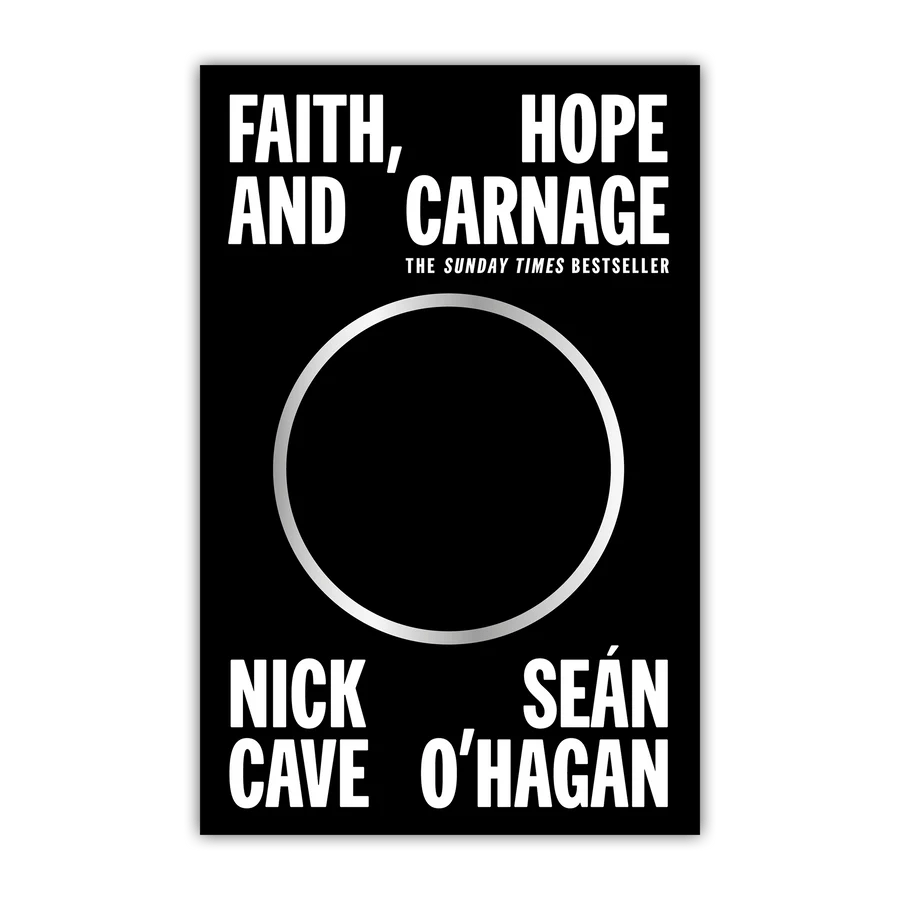
A Reflection
Despite my admiration of Nick Cave, I have been hesitant to write about him for a number of reasons. Firstly, he is involved in such a wealth of creative projects and has undergone so much change since the beginning of his career, that the prospect of researching him and providing an appropriately comprehensive summary of his work is a daunting and overwhelming task. Secondly, the man himself has expressed a distinct dislike for the interview format – criticising editorial interviews as “a few decontextualised quotes thrown into a preconceived narrative” – and I find myself wondering how writing a review on someone’s personal thoughts and life is any different. That being said, the motivation behind my writing is to discuss art that moves me, and with that as my premise, this book is a beautiful example. Cave describes Faith, Hope and Carnage as “a slice of time”, a statement that ameliorates my unwillingness to delve into his complex past and allows a wonderfully liberating opportunity to discuss this book by itself, without the worry of missing anything out. This will not be a book summary – there are plenty out there if you’re interested – instead this will be a reflection on the thoughts this book has inspired.

First Impressions
My immediate impressions surrounding Faith, Hope and Carnage undeniably centre around the heartbreaking intimacy offered by Cave. I think people are correct in calling this book an act of generosity – the book is not self-aggrandising, or pretentious, or lecturing. In fact, at times it was difficult to read because of the vulnerability of what was being shared regarding Cave’s ruminations on grief, addiction and the forceful “transformation” that losing his child imposed upon him. However, the book is not a miserable indulgence in personal tragedy. It also contains humorously self-deprecating passages on the nature of rock and roll, revealing anecdotes involving big industry names and an insight into the more domestic aspects of Cave’s everyday. It is precisely this parallel between devastating loss and the complexity of a creative life which lends the book its appeal. It personifies the man behind the name.
Sean O’Hagan’s Role
The intimate and conversational nature of the book works particularly well due to the dynamic between Sean O’Hagan and Cave. Removed from the cold professionalism that usually inhabits interviews, the friendship between the two men – who are clearly united by their extensive knowledge and passion for music – transforms this set of discussions. Although this book relies upon Cave’s eloquence, frankness, and his gravitation toward abstract ideas, it is O’Hagan’s empathy, humility and the space he provides that gently guides Faith, Hope and Carnage away from being an overwhelming submergence in grief. O’Hagan retains a lightness and ease throughout, whilst simultaneously facilitating and encouraging difficult, meandering conversations. His role as an admirer and friend of Cave takes precedent over his role as journalist, and this successfully allows the interview to breathe and operate under an empathy and respect that feels novel to the interview format.

“Talking can often reflect back on us the folly of our own ideas” – Nick Cave (p.270)
An element to the dialogue between the two friends that I found particularly complimentary was the reflection of both men in-between conversations. Often, O’Hagan would highlight something Cave mentioned previously that he didn’t understand, or Cave would express a desire to re-explain something he felt he didn’t articulate in the way he wanted to. This made the abstract nature of the wandering conversations feel cohesive and contemplative. The topics within Faith, Hope and Carnage refuse to follow a linear structure, but the revisiting of conversations paralleled Cave’s assertion; “although we feel we are moving in a forward direction, in my estimation we are forever moving in a circular way”.
“God cannot be defended, hence we must” – Nick Cave (p.203)
Despite my personal disinclination, it would be impossible not to mention the underlying themes of faith and belief present in Faith, Hope and Carnage. In their final ‘conversation’, Cave and O’Hagan meditate on the positive public response to their project, something Cave attributes to their “open and uncynical” approach. O’Hagan’s personal dubiousness surrounding God and organised religion did not restrict or dictate conversations regarding these subjects. Cave’s sustained preoccupation with faith is an enduring presence throughout Faith, Hope and Carnage, ultimately accumulating in his arrival that regardless of the impossibility of a solution, he finds a great deal of comfort in the existence of the irrational.
Another Side to Nick Cave
I’ve touched on this already, but this book not only demonstrates Cave’s ability to articulate complex and abstract reflections on death, art, religion and music, it also provides a more human side to this larger-than-life figure. Although I adore the majority of Cave’s discography, before reading Faith, Hope and Carnage I knew surprisingly little about the artist’s projects outside of his music. This book instilled in me an interest in Cave’s Red Hand Files, his disarming obsession with ceramics and his catalogue of published books and essays. This book feels like a personal introduction to Nick Cave and reveals another side to the artist. I’ve always viewed Cave’s work as creative, driven, humorous and articulate, but his conversations with O’Hagan reveal a person who is thoughtful, vulnerable and kind. His persistent emphasis on the necessity of adaptation illustrates an empathetic, cautionary personality that is compellingly disparate to Cave’s murky history within violent, punk-infused rock music.

Final Thoughts
You do not have to be a die-hard Nick Cave fan to find value in this book. Although the events of his singular life provide the structure to Faith, Hope and Carnage, in a much bigger way, this conversational book is simply a meditation on the shared human experience. It reflects on the universal nature of loss, addiction, family, work, faith and hope; expressed in a classically Nick Cave-style.
 livlistens.com
Leave a comment